The short version: get these right and you remove most non-compliances
- Hold your test standards and Building Regulations on site, offline and to hand.
- Keep every piece of equipment in calibration and registered on the SITMA Portal.
- Evidence current public liability and professional indemnity insurance with SITMA.
- Know your sampling: the right number of tests, groups and sub-groups, and what happens after a fail.
-
Set up with care every time, respect measurement geometry, and control the test
conditions. - Issue reports on time and declare any deviation from standard.
Every SITMA audit is designed to protect the integrity of sound insulation testing and the confidence that clients, building control bodies and homeowners place in a certified tester. Most findings raised at audit are avoidable, and they tend to cluster around a small number of recurring themes. Knowing these themes in advance is the single best way to arrive at an audit prepared and to keep your testing compliant between audits. The sections below set out the areas that most frequently give rise to non-compliances, in rough order of how often we see them.
1. Test standards and reference documents not held or not accessible
The most common documentation finding is a tester who cannot produce the test standards they are working to, or who owns them but cannot access them at the point of testing. The scheme requires you to hold, and have available without an internet connection, the standards relevant to the work you are certified for. The same applies to the Building Regulations or Approved Guidance you are testing against. A related issue is the inability to locate supporting guidance for unusual site situations, such as the additional material contained within the wider ISO 140 series. Keep controlled copies with your test equipment and know where the answers sit before you need them.
2. Equipment calibration not current or not evidenced
Calibration findings are among the most frequent of all. Not calibrating the measuring system in the field after the test, using the sound calibrator. This is particularly important because checking the calibration after the testing is completed confirms that the sound level meter was working during your measurements and confirms that the data you have collected is within its calibrated tolerances.
SITMA also recommends calibrating before you go for lunch, and after leaving the sound level meter unattended for any period of time.
3. Equipment not registered on the SITMA Portal
Testing with equipment that has not been registered on the SITMA Portal is an entirely preventable finding, but one that holds the most serious consequences. Using equipment not registered on the portal risks your accredited certification with SITMA.
Every item you test with, including the sound level meter, speaker, amplifier, calibrator and tapping machine, must be declared on the Portal with its serial number and supporting evidence. There have been occasions where the calibration evidence is not valid, which means the testing conducted is not valid and cannot be used.
4. Insurance not in place or not provided to SITMA
Testers are regularly unable to evidence current public liability and professional indemnity insurance at the time of audit. In many cases the cover exists but the certificate has not been supplied to SITMA or uploaded to the Portal. Diarise your renewal dates and send the updated certificates to SITMA as soon as they are issued, rather than waiting to be asked.
5. Sampling and the number of tests
A significant group of findings concerns the number of tests carried out on a site. The most frequent is a tester who cannot confirm that testing must be increased following a failed test of a particular construction type. Others include planning fewer tests than the Building Regulations recommend as a minimum, and a lack of clarity around groups and sub-groups, which can result in too few tests being conducted. Make sure you can identify, and point to, the part of the guidance that dictates how many tests a given site requires.
6. Set-up, positioning and measurement geometry
Several findings arise from the physical set-up of a test. Recurring examples include microphone or speaker positions placed closer than 0.5m to room boundaries or diffusers, positions that do not meet the minimum spacing between one another, a microphone placed too close to the sound source, and a loudspeaker that is not moved vertically between source positions. Room volumes not being measured, or the larger room not being identified in advance, also features regularly. Careful, measured set-up on every position removes most of these findings at a stroke.
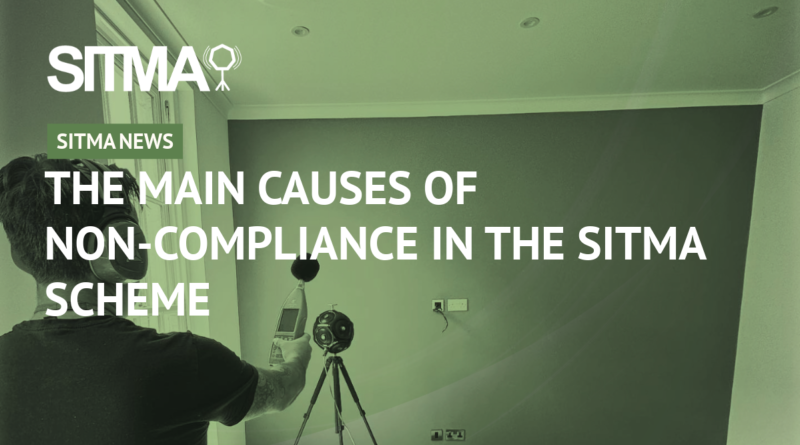
A substantial proportion of room boundaries findings are due to the sound level meter being placed too close to the ceiling. A typical ceiling height in UK new-build construction is 2.4m. Takeaway the required 0.5m leaves us with 1.9m, or a little over 6 feet. Unless the ceiling height is greater than 2.4m, the sound level meter should seldom be moved above head height!
7. Reverberation time and minimum measurement positions
Findings frequently relate to reverberation time measurement, where the minimum number of decays or microphone positions has not been met, and to the minimum number of measurement positions required by the standard more broadly. Understanding and applying the required number of positions for each measurement type is a straightforward way to avoid this category entirely.
For England, Wales and Northern Ireland, a minimum of 6 individual decays need to be measured, at 3 different measurement positions. Each measurement position should have two distinct decays. You will receive a non-compliance if you take 6 readings in 6 different microphone positions.
8. Test conditions and flanking paths
Tests are sometimes conducted with windows or doors that are not fully closed for the duration of the measurement, which introduces flanking paths the standard is designed to exclude. Confirm the room is in the correct condition before you begin, and do not disturb the source once measurement has started. Where test conditions are not ideal, see the reporting and declaring deviations section below!
9. Reporting and declaring deviations
The final recurring theme concerns what happens after the test. Reports are sometimes not issued within the required timescale, and deviations from the test standard are sometimes not declared on the Lodgement Portal or within the final report. Where a test departs from standard for a legitimate reason, record it clearly and promptly, and issue the report within the required window.
In summary
The pattern across these findings is consistent. Non-compliances rarely come from a lack of skill on site. They come from documentation, calibration, registration and administration that has slipped, and from set-up habits that drift over time. Treating the areas above as a routine pre-test discipline will keep the overwhelming majority of testers fully compliant, audit after audit.