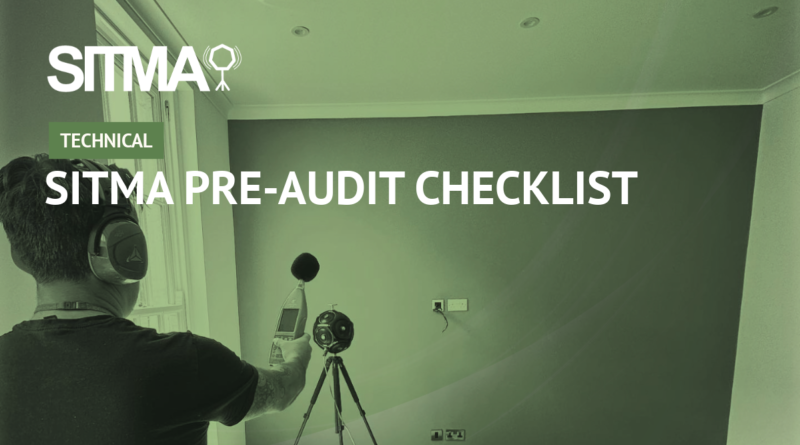
Everything to prepare, hold and check before your audit and before every test
Use this checklist to prepare for a SITMA audit and to build good habits into your everyday testing. It is organised in the order you would work through it, from the documents and equipment you need in advance, to the checks you carry out on the day, to the actions you complete after testing. Working through it before every job, not just before an audit, is the surest way to keep your certification in good standing.
A. Documents to hold and have accessible on site
- A controlled copy of every test standard you are certified to work to, available on site without needing an internet connection.
- A copy of the Building Regulations or Approved Guidance relevant to the site, for the correct home nation, also available offline.
- Access to the wider ISO 140 series guidance, so you can locate supporting information for unusual or special site situations.
- Confirmation that your documents are stored somewhere reliable, such as your laptop desktop, rather than on a single memory stick that may be left behind.
B. Equipment, Calibration and the SITMA Portal
- Sound level meter calibrated within the required period, covering the full scope the scheme requires, including reverberation time and filters, by an ILAC accredited laboratory.
- Tapping machine calibrated within the required period, with its one-off checks completed and recorded.
- Sound calibrator calibrated within the last twelve months and producing its stated level at 1000Hz.
- Speaker stability check completed, current and uploaded to the SITMA Portal.
- Speaker directivity check completed, current and uploaded to the SITMA Portal.
- Every item of equipment registered on the SITMA Portal, with serial numbers on the Portal matching the physical equipment in your kit.
- Where fitted, the microphone cover or shroud in place so the meter performs to the required accuracy class.
- Calibration expiry dates diarised well ahead, allowing for laboratory lead times so you are never caught without equipment.
C. Insurance
- Current public liability insurance in force, with the certificate supplied to SITMA and uploaded to the Portal.
- Current professional indemnity insurance in force, with the certificate supplied to SITMA and uploaded to the Portal.
- Renewal dates diarised, with updated certificates sent to SITMA as soon as they are issued.
D. Planning the site and sampling
- The correct number of tests identified in advance, in line with the minimum recommended by the relevant Building Regulations.
- A clear understanding of groups and sub-groups for the site, so the correct number of tests is planned.
- Confirmation that you can identify and point to the part of the guidance that dictates the number of tests required.
- An understanding that testing must be increased following a failed test of a particular construction type.
- Access to all rooms, plots and commercial spaces arranged in advance, with the client and any occupants informed of what is needed.
- Confirmation that test areas will be complete and testable, with doors fitted, permanent power available and rooms suitably prepared.
E. On the day, before your begin
- The measuring system calibrated with the sound calibrator before testing, and again after testing.
- Room volumes measured, and the larger room identified so the test is conducted in the correct direction.
- Windows and doors fully closed for the duration of the test, with any unavoidable exceptions recorded as a deviation.
- Trickle ventilators and other additional flanking paths closed.
F. During the test, set-up and geometry
- Microphone and speaker positions kept at least 0.5m from room boundaries and diffusers.
- Minimum separation maintained between microphone positions, and between speaker positions.
- Microphone positions kept the required minimum distance from the sound source.
- Loudspeaker moved vertically, as well as horizontally, between source positions.
- The minimum number of measurement positions met for both airborne and impact tests.
- The minimum number of reverberation time decays and positions met, with the reverberation time measured in the correct room.
- The sound source left undisturbed once measurement has started, with its position and output level unchanged.
G. After the test, reporting and records
- The report issued within the required timescale.
- Any deviation from the test standard clearly declared on the Lodgement Portal and within the final report.
- Site notes and photographs kept to a standard that fully and accurately describes the conditions witnessed.
- Any outstanding audit actions closed out using Form FOS032, with supporting evidence, by the agreed date.